
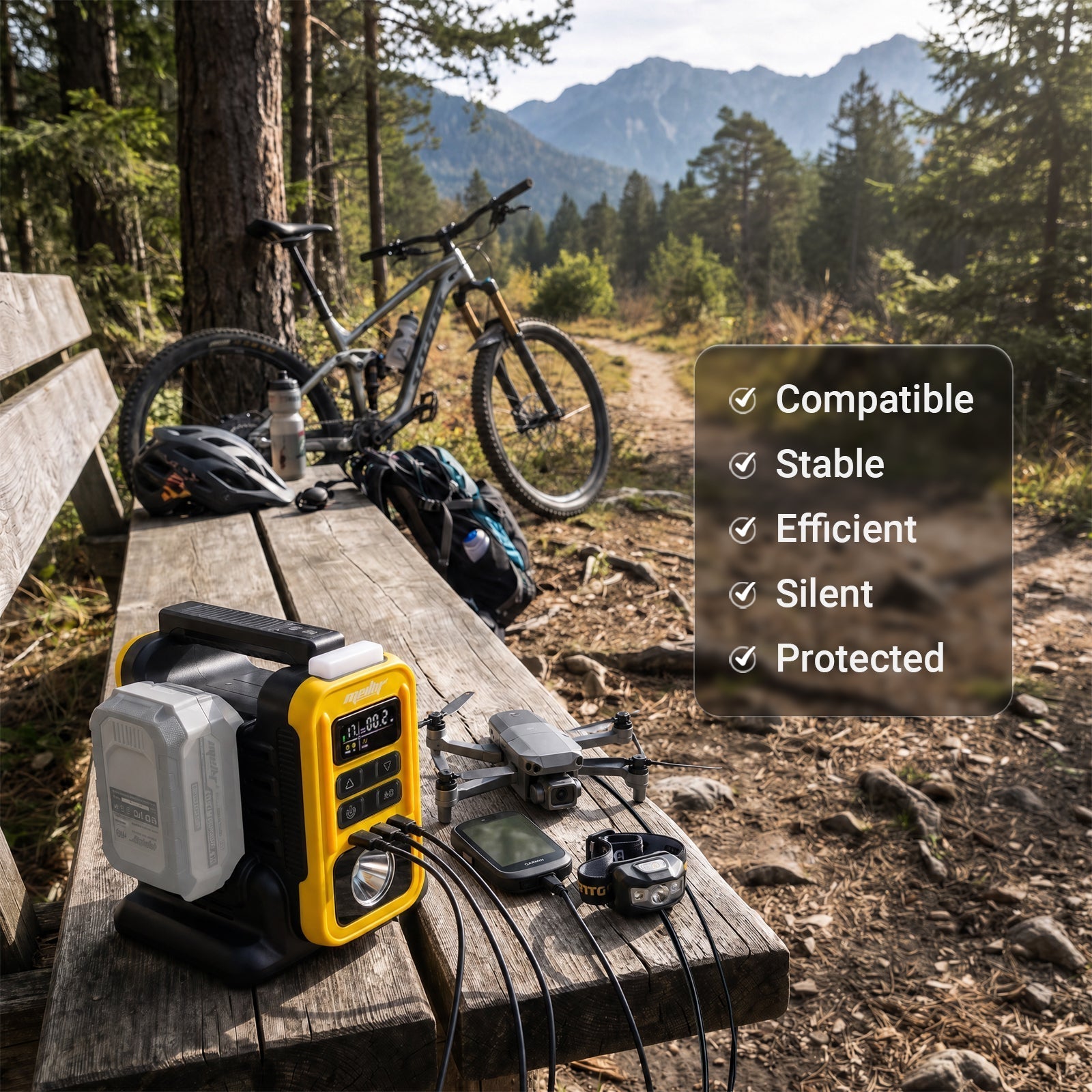
Have you ever wondered how you can use a battery to power a device that normally plugs into a wall outlet? That’s where an inverter comes in.
Simply put, an inverter converts DC (direct current) power into AC (alternating current) power. This makes it possible to use compatible AC-powered devices when you're away from a traditional electrical outlet.
From camping trips and outdoor projects to RV adventures and emergency situations, a portable inverter can be a convenient way to bring power wherever you need it.
How Does an Inverter Work?
Most rechargeable batteries provide DC power, while many household appliances and electronic devices use AC power.
An inverter converts the electricity from the battery into AC power that compatible devices can use:
Battery → Inverter → AC Power → Your Device
For example, a portable inverter can take power from a compatible 18V battery and convert it into usable AC power, allowing you to charge or power compatible devices when you're away from a wall outlet.


What Can You Use a Portable Inverter For?
One of the biggest advantages of a portable inverter is its versatility.
Imagine you're camping and need to charge your laptop, keep your phone powered up, or use a small fan. Instead of searching for a wall outlet, you can use a compatible battery with an inverter.
A typical portable inverter may offer several output options, including an AC outlet and USB ports. This allows you to power different types of devices from one compact unit.
Depending on the inverter and the power requirements of your devices, it can be useful for:
-
Laptops
-
Smartphones
-
Tablets
-
Cameras
-
Drones
-
Radios
-
USB-powered lights
-
Mini fans
-
Other compatible low-power electronics
Always check the power requirements of your device before connecting it to an inverter.
Where Can You Use a Portable Inverter?
The beauty of a battery-powered inverter is that you don't have to stay close to a wall outlet.
Camping
Whether you're spending one night outdoors or taking a longer camping trip, an inverter can provide convenient power for compatible electronics, lights, and other small devices.
RV Trips
An inverter can be a useful addition to your RV setup when you need portable power for compatible devices while traveling or camping.
Jobsites
At a jobsite without convenient access to electricity, a portable inverter can provide AC power for compatible low-power electronic equipment.
Fishing, Hiking, and Outdoor Gatherings
Its compact and portable design makes it easy to bring along for fishing trips, hiking, picnics, outdoor parties, and other activities.
Emergency Situations
Power outages can happen unexpectedly. Having a battery-powered inverter available can give you an additional source of power for compatible electronics and lighting when you need them most.
Inverter vs. Generator: What's the Difference?
Inverters and generators are sometimes confused because both can provide power when you're away from a wall outlet. However, they work in different ways.
A generator produces electricity, typically using an engine.
An inverter converts electricity from a DC power source, such as a battery, into AC power.
This means a battery-powered inverter doesn't need gasoline or an engine. It can be a quieter and more convenient option for smaller power needs, especially if you already own compatible rechargeable batteries.
Safety Tips for Using an Inverter
A few simple precautions can help you use your inverter safely:
-
Check the device's power requirements before connecting it.
-
Do not exceed the inverter's rated output.
-
Make sure the battery is correctly installed.
-
Use the correct battery and connectors.
-
Keep ventilation openings clear.
-
Keep the inverter away from water and excessive moisture.
-
Do not use damaged batteries, cables, or connectors.
-
Remove the battery when the inverter is not in use.
- Follow the manufacturer's instructions before operating the inverter.
How Do You Choose the Right Inverter?
Before choosing an inverter, consider a few key specifications.
1. Output Power
First, check how much power your device requires.
The inverter's rated output should be high enough to handle the connected device. Remember that some devices, especially those with motors, may require additional power when starting.
2. Battery Compatibility
Make sure the inverter is designed for your battery system.
If you already have compatible 18V batteries, choosing an inverter that works with the same battery platform can be a convenient and cost-effective option.
3. Output Voltage
Check the voltage required in your region and by your devices.
For example, European versions commonly use 220–230V, while versions designed for the US and Canada use 110V.
4. Output Ports
Think about what you plan to connect.
An AC outlet is useful for compatible AC-powered devices, while USB-A and USB-C ports are convenient for phones, tablets, cameras, and other USB-powered electronics.
5. Waveform
If you plan to power electronic equipment, consider choosing a pure sine wave inverter for smooth and stable AC output.
What Is a Pure Sine Wave Inverter?
If you've been shopping for an inverter, you may have come across the term "Pure Sine Wave."
But what does it actually mean?
A pure sine wave inverter produces an AC output waveform that closely resembles the electricity supplied by a standard household outlet.
This provides smooth and stable power, making pure sine wave inverters a good choice for many electronic devices.
For people who want to power devices such as laptops, cameras, and other sensitive electronics, a pure sine wave inverter can provide an additional level of confidence when choosing a portable power solution.
Meet the Upcoming Mellif 350W Portable Outdoor Inverter
If you're looking for a portable inverter for your next outdoor adventure, Mellif's 350W Portable Outdoor Inverter is coming soon and is now available for pre-sale.
Designed to work with compatible 18V batteries, it converts battery power into AC power and offers several output options for everyday electronics.
Depending on the regional version, it is available with 220–230V AC output for Europe or 110V AC output for the US and Canada.
The inverter provides:
- 1 × AC output: 220–230V or 110V, depending on the regional version
- 2 × USB-A: 5V / 2.1A
- 1 × USB-C: PD 3.0, 18W
- Maximum output: 350W
-
Pure sine wave output

This gives you a convenient way to power or charge compatible devices when you're away from a traditional wall outlet.
More Than Just Power: An Emergency LED Light
A portable inverter can be useful for more than simply powering electronic devices.
For example, the upcoming Mellif 350W Portable Outdoor Inverter also features a built-in 300-lumen LED light with two brightness levels.

This can be especially useful when you're outdoors after dark, working in a dim area, or dealing with an unexpected power outage.
Instead of carrying a separate light and power source, you can have both functions in one compact device.
Multiple Ways to Charge and Power Your Devices
Different devices require different types of connections, so having multiple output options can make a portable inverter much more convenient.
The Mellif 350W Portable Outdoor Inverter includes an AC outlet, two USB-A ports, and a USB-C PD port.
The AC outlet can be used for compatible AC-powered devices, while the USB ports are convenient for smartphones, tablets, and other USB-powered electronics.
With a maximum output of 350W, it is designed for compatible low-power devices rather than high-power appliances.
Built-In Safety Protection
Whenever you're working with batteries and electrical equipment, safety is an important consideration.
A portable inverter with a built-in Battery Management System (BMS) can provide several layers of protection during operation.
The Mellif inverter includes protection against:
-
Overcurrent
-
Overvoltage
-
Overheating
-
Overload
-
Short circuit
These safety features are designed to help protect the inverter and connected equipment during use.
As an additional precaution, remember to remove the battery when the inverter is not in use.
Share:
Bandfile Sander: What Is It and What Can You Use It For?
How to Choose the Right Nibbler?