Have you ever tried to sand a narrow corner, smooth a weld, or remove rust from a tight space, only to find that your regular sander is simply too large?
This is where a bandfile sander can make a difference.
With a narrow sanding belt and compact design, a bandfile sander is designed for detailed work that can be difficult with conventional sanding tools. From metal finishing and weld smoothing to woodworking and paint removal, it can handle a wide range of smaller sanding jobs.
In this guide, we'll explain what a bandfile sander is, where it works best, how it compares with other tools, and what to consider when choosing one.
What Is a Bandfile Sander?
A bandfile sander, also known as a power file or detail belt sander, is a compact sanding tool that uses a narrow continuous sanding belt.
Unlike a conventional belt sander, which is generally designed for larger surfaces, a bandfile is built for more precise work and areas where a larger sanding tool may be difficult to maneuver.
The narrow belt and elongated sanding arm make it suitable for applications such as:
-
Weld finishing
-
Deburring metal edges
-
Rust and paint removal
-
Detailed woodworking
-
Surface preparation
-
Sanding narrow or irregular surfaces
7 Practical Uses for a Bandfile Sander
1. Smoothing Welds
After welding, joints may need additional sanding to create a smoother surface before painting, coating, or further fabrication.
A bandfile can be particularly useful for finishing welds on metal frames, tubing, brackets, railings, and similar projects.
2. Removing Burrs From Metal
Cutting and machining can leave sharp edges and burrs on metal parts.
A sanding belt can help smooth these areas and prepare components for assembly or finishing.
3. Sanding Inside Corners
Corners and recessed areas can be challenging with conventional sanders because the sanding pad or belt may not fit properly.
A narrow sanding arm allows a bandfile to work more easily in these confined areas.
4. Removing Rust and Paint
Abrasive belts can be used to remove surface rust, old paint, and other unwanted material from metal.
Using the appropriate grit allows you to move from heavier removal to surface finishing as the project progresses.
5. Smoothing Curved or Irregular Surfaces
The narrow belt can be easier to maneuver around smaller curves and irregular shapes than a larger sanding tool.
This can be useful when working with pipes, tubing, shaped metal, or detailed wooden components.
6. Detail Sanding for Woodworking
Bandfiles aren't limited to metalworking. With a suitable sanding belt, they can also be used for detailed woodworking.
Potential applications include:
-
Narrow edges
-
Curved sections
-
Furniture details
-
Small wooden components
-
Shaped surfaces
7. Finishing Hard-to-Reach Areas
Some sanding jobs simply require a smaller and more maneuverable tool.
If you need to remove material or smooth a surface that is difficult to access with a conventional sander, a bandfile can provide a practical alternative.
Bandfile Sander vs. Belt Sander vs. Angle Grinder
Different tools are designed for different types of work.
| Tool | Best for | Main advantage |
|---|---|---|
| Orbital Sander | Large, flat surfaces | Smooth general finishing |
| Belt Sander | Larger surfaces | Fast material removal |
| Angle Grinder | Heavy grinding and cutting | High material removal |
| Hand File | Small precision jobs | Simple and precise |
| Bandfile Sander | Detailed and confined sanding | Access and control |
A bandfile isn't intended to replace every sanding or grinding tool. Instead, it occupies a useful middle ground between manual filing and larger power tools.
Bandfile Sander vs. Angle Grinder: Which Should You Choose?
An angle grinder is often the better choice when you need aggressive grinding or cutting.
A bandfile is more suitable when the job requires controlled sanding, finishing, or access to smaller areas.
For example:
Choose an angle grinder when you need:
-
Cutting
-
Heavy grinding
-
Fast material removal
Choose a bandfile when you need:
-
Weld finishing
-
Deburring
-
Edge smoothing
-
Rust or paint removal
-
More controlled sanding
The right choice ultimately depends on the type of work you're doing and how much material you need to remove.
What to Look for When Choosing a Bandfile Sander
Before choosing a bandfile, consider a few key features.
Belt Speed
A higher belt speed can help with faster material removal, while lower speeds can provide more control for finishing work.
Variable Speed
Multiple speed settings allow you to adapt the tool to different materials and applications.
Belt Size
Check the belt dimensions and whether the tool uses a commonly available belt size. Standard-size belts can make replacements easier to find.
Belt Replacement
A tool-free belt change system is useful when switching between different grits or replacing worn belts.
Weight and Ergonomics
Because bandfiles are often used for detailed work, a lightweight and ergonomic design can make the tool easier to control, especially during longer jobs.
Battery Compatibility
For cordless tools, battery compatibility can be an important consideration. If you already own compatible batteries, a tool-only option may allow you to expand your existing tool collection without purchasing another battery.
How to Choose the Right Sanding Belt
The right grit depends on the type of work you're doing.
P40 — Heavy Material Removal
Best suited for:
-
Rust removal
-
Paint removal
-
Removing excess material
P80 — General Sanding
Useful for:
-
Weld smoothing
-
General metal finishing
-
Surface preparation
-
Wood sanding
P120 — Fine Finishing
Use P120 when you need a smoother surface after the initial sanding stages.
For many projects, a simple progression is:
P40 → P80 → P120
Start with the coarser grit and gradually move to finer abrasives as the surface becomes smoother.
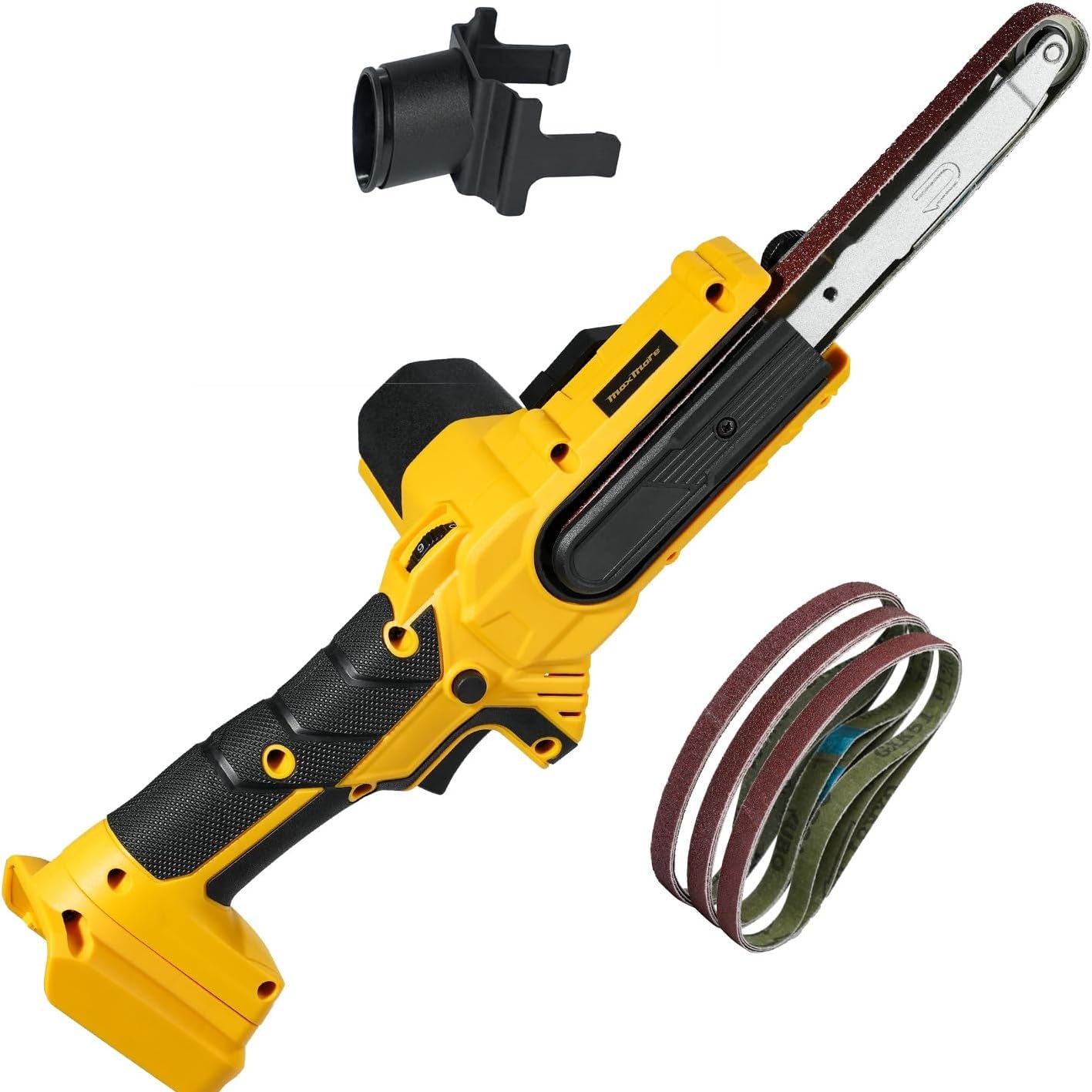
Meet the MaxMore MFDSB01 Detail Bandfile Sander
The MaxMore MFDSB01 is designed for detailed sanding, grinding, polishing, and surface preparation on wood, metal, and plastic.
 Up to 2,100 FPM Belt Speed
The MFDSB01 delivers a maximum belt speed of 2,100 FPM, providing fast sanding performance for a variety of applications.
6 Variable Speeds

With 6 adjustable speed settings, you can select a suitable speed for different materials and tasks, from detailed finishing to faster material removal.
Tool-Free Belt Changes

The MFDSB01 allows you to change sanding belts without additional tools.
It uses standard 1/2" × 18" (13 × 457 mm) belts and includes:
-
P40
-
P80
-
P120
This gives you different abrasive options for heavier sanding, general-purpose work, and finishing.
Compact 1.9-lb Design

Weighing just 1.9 lbs, the MFDSB01 is designed for comfortable one-hand operation.
Its lightweight construction makes it easier to maneuver when working on detailed areas or smaller workpieces.
Safety and Protection

The MFDSB01 includes a safety lock and built-in low-voltage and overcurrent protection for added protection during operation.
Dewalt 20V Max Compatible
The MFDSB01 works with Dewalt 20V Max and Mellif 20V batteries.
Battery not included.
MaxMore MFDSB01 Specifications
| Feature | Specification |
|---|---|
| Model | MFDSB01 |
| Belt Speed | Up to 2,100 FPM |
| Speed Settings | 6 Variable Speeds |
| Belt Size | 1/2" × 18" (13 × 457 mm) |
| Included Belts | P40 / P80 / P120 |
| Weight | 1.9 lbs |
| Battery Compatibility | Dewalt 20V Max / Mellif 20V |
| Battery | Not Included |
| Belt Change | Tool-Free |
| Protection | Low-Voltage & Overcurrent Protection |
| Safety | Safety Lock |
Share:
Spend More Time Fishing, Less Time Filleting: Upgrade Your Fish Cleaning Game
What Is an Inverter? A Simple Guide to Portable Power
1 comment
When will these be available.
I need to evaluate one to see if they will be suitable for our workforce.
Could I get one on trial ?